

Who Was Melchizedek in the Bible? A Clear Biblical Answer
Who Was Melchizedek in the Bible?
Melchizedek is one of the most mysterious people in the Bible. He appears suddenly in Genesis, blesses Abraham, receives a tithe, and then disappears from the story. Centuries later his name surfaces again in Psalm 110, and then becomes a centerpiece of the book of Hebrews and its teaching about Jesus Christ.
Because of this, people ask a lot of questions. Who was Melchizedek? Was Melchizedek Jesus? Was he God? Was he an angel? Did Melchizedek have parents? Was he Shem? Was he a real man who walked the earth?
The biblical answer is powerful and clear: Melchizedek was a real historical priest king who lived in the days of Abraham, and God used him as a prophetic foreshadowing of Jesus Christ. He is one of the clearest Old Testament pictures of Christ as both King and Priest.
In this article we will walk through the story of Melchizedek, define the terms, answer the common objections, and show you how to bring the whole conversation back to Jesus.
Where Is Melchizedek Mentioned in the Bible?
Melchizedek is named in only three places in all of Scripture:
Genesis 14:18–20
Psalm 110:4
Hebrews 5–7
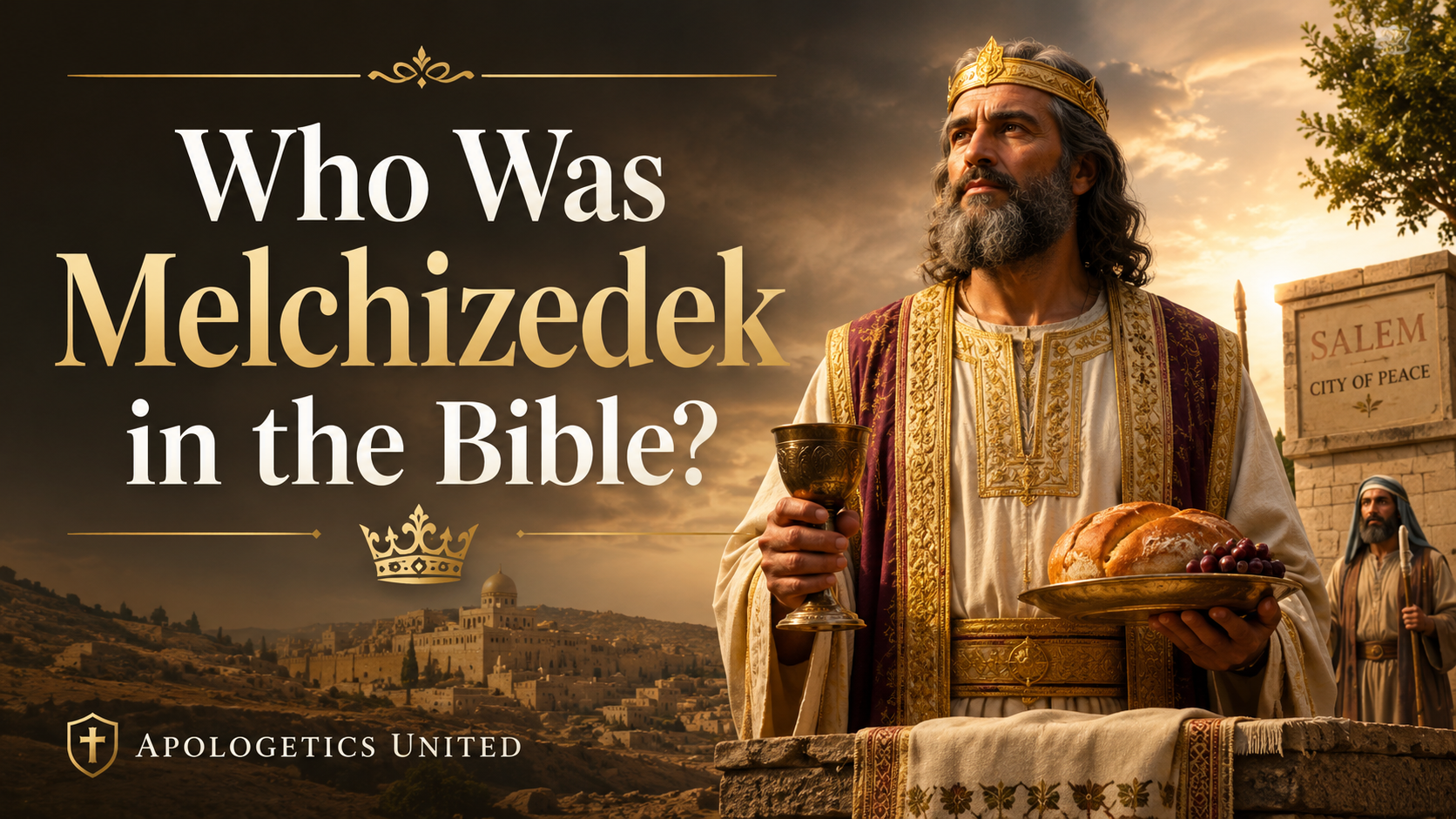
His first appearance is in Genesis 14. Abraham had just rescued his nephew Lot after defeating a coalition of kings. On the way home, two kings come out to meet him: the king of Sodom and Melchizedek, king of Salem.
“Then Melchizedek king of Salem brought out bread and wine; he was the priest of God Most High. And he blessed him and said, ‘Blessed be Abram of God Most High, Possessor of heaven and earth.’” (Genesis 14:18–19, NKJV)
That short passage tells us a great deal. Melchizedek was a king. He was a priest. He served the true God, called “God Most High.” He lived during the time of Abraham. And Abraham honored him.
This matters because Abraham is one of the most important figures in the Bible. He is the father of the nation of Israel, the man who received the covenant promises, and the one through whom God promised that all nations would be blessed. Yet Abraham receives a blessing from Melchizedek and gives him a tenth of the spoils. Melchizedek was no ordinary man in the narrative. He held a unique spiritual office.
The Contrast: Melchizedek and the King of Sodom
Genesis 14 sets two kings side by side on purpose. The king of Sodom offers Abraham the plunder and tries to enrich him. Abraham refuses, swearing he will not take “from a thread to a sandal strap” (Genesis 14:23) so that no one could say the king of Sodom made him rich.
But to Melchizedek, the priest of God Most High, Abraham gives a tenth of everything. The contrast is striking. Abraham turns down the wealth of a wicked king but freely honors the priest who blesses him in the name of the true God. The story is quietly teaching us where real greatness and real worship belong.
What Does the Name Melchizedek Mean?
The name Melchizedek means “king of righteousness.” Hebrews 7:2 explains this directly and then adds that he was also king of Salem, which means “peace.” So Scripture presents him with three titles stacked together:
King of Righteousness
King of Peace
Priest of God Most High
That alone should make a Christian pause. Who is the true King of Righteousness? Jesus Christ. Who is the true King of Peace? Jesus Christ. Who is the true High Priest who brings us to God? Jesus Christ. This does not automatically mean Melchizedek was Jesus, but it does show that God designed Melchizedek to point forward to Him.
Was Melchizedek a Real Person?
Yes. Genesis presents Melchizedek as a real king and priest who interacted with Abraham. The text does not introduce him as a parable, a symbol, a myth, or an angelic vision. He is described in plain historical terms: he is called king of Salem, he brings out bread and wine, he blesses Abraham, and he receives a tithe. Those are the actions of a real man in a real place.
The safest biblical position is that Melchizedek was a real historical man who served as both king and priest. But he was also more than a footnote of history. He was a type of Christ.
A “type” is a person, event, or institution in the Old Testament that points forward to a greater fulfillment in Jesus Christ. For example:
Adam points forward to Christ as the head of a new humanity.
The Passover lamb points forward to Christ as the Lamb of God.
David points forward to Christ as the greater King.
The temple points forward to Christ as the presence of God among His people.
In the same way, Melchizedek points forward to Jesus as the greater King and the eternal High Priest.
Was Melchizedek a Prophet?
The Bible never directly calls Melchizedek a prophet. He was a priest and a king, but Scripture does not assign him the title of prophet. This matters because we should be careful not to give biblical figures titles that the Bible itself withholds. Melchizedek spoke a blessing from God and clearly served the true God, but his stated offices in Scripture are “king of Salem” and “priest of God Most High.” The most faithful answer is simply that Melchizedek was a real priest king who served God Most High and foreshadowed Jesus Christ.
Was Melchizedek Shem?
Some ask whether Melchizedek was actually Shem, the son of Noah, living on under a different name. This idea did not come from the Bible. It comes from later Jewish tradition (found in some rabbinic writings and the Targums), which tried to fit Melchizedek into a known genealogy.
The problem is that the Bible never makes this identification, and the whole point Hebrews draws from Melchizedek is the opposite. Hebrews highlights that Melchizedek appears in the record without a stated genealogy, precisely so he can serve as a picture of a priesthood that does not depend on family line. If Melchizedek were openly identified as Shem, with a famous father and a recorded lifespan, the argument of Hebrews 7 would lose its force.
So the careful answer is: there is no biblical evidence that Melchizedek was Shem. It is a tradition, not a teaching of Scripture, and it actually works against what the text is doing.
Note for editors: The rabbinic identification of Melchizedek with Shem is well attested in Jewish tradition; the specific sources should be verified before publishing if we cite them by name.
Why Did Abraham Give Melchizedek a Tithe?
Genesis 14 says Abraham gave Melchizedek a tenth of everything. That is significant. Abraham was the man who received God’s covenant promises, and yet he honors Melchizedek by giving him a tithe.
Hebrews 7 explains why this matters with a simple principle: the lesser is blessed by the greater. Since Melchizedek blessed Abraham, Melchizedek is being presented as greater in priestly rank. This does not mean Melchizedek was greater than Abraham in every way. It means he held a superior priestly position in that moment. Abraham was great because of the covenant promises God gave him. Melchizedek was great because he represented a priesthood higher than the later Levitical priesthood. That distinction becomes crucial when we get to Jesus.
What Is the Order of Melchizedek?
Psalm 110:4 says:
“The LORD has sworn and will not relent, ‘You are a priest forever according to the order of Melchizedek.’” (Psalm 110:4, NKJV)
Psalm 110 is a Messianic psalm. It points forward to the Messiah, who would be both King and Priest. This is striking, because under the Law of Moses, priests came only from the tribe of Levi. But Jesus came from the tribe of Judah. That raises a serious question: how can Jesus be our High Priest if He is not from Levi?
Hebrews answers by pointing to Psalm 110. Jesus is not a priest after the order of Aaron or the Levitical priesthood. He is a priest after the order of Melchizedek. His priesthood is older, greater, and eternal. Compare the two:
The Levitical priests served temporarily. Jesus serves forever.
The Levitical priests offered sacrifices repeatedly. Jesus offered Himself once for all.
The Levitical priests died and had to be replaced. Jesus lives forever and has an unchangeable priesthood.
That is why Melchizedek matters. He prepares us to understand the priesthood of Jesus Christ.
Was Melchizedek Jesus?
This is one of the biggest questions people ask. Some Christians believe Melchizedek was a pre-incarnate appearance of Jesus, called a Christophany (an appearance of Christ before His incarnation).
The stronger biblical view, however, is that Melchizedek was not Jesus Himself, but a foreshadowing of Jesus. The key is Hebrews 7:3, which says Melchizedek was “made like the Son of God.” Notice the wording. It does not say Melchizedek was the Son of God. It says he was made like the Son of God. That language points to comparison, not identity.
In other words, Melchizedek resembles Christ. He points to Christ. He is patterned in a way that helps us understand Christ. But he is not Christ Himself. The Bible consistently presents Jesus as greater than every shadow that came before Him. The shadow is not the substance. The picture is not the fulfillment. Melchizedek is the shadow; Jesus is the substance.
What Does “Without Father, Without Mother, Without Genealogy” Mean?
Hebrews 7:3 says Melchizedek was “without father, without mother, without genealogy, having neither beginning of days nor end of life.” This verse has caused a lot of confusion. Some read it to mean Melchizedek literally had no parents and never died. But that is not the best interpretation, and the context tells us why.
The context of Hebrews 7 is priesthood. Under the Law of Moses, a priest’s genealogy mattered enormously. To serve as a Levitical priest, a man had to prove he descended from the tribe of Levi and the family line of Aaron. No genealogy, no priesthood.
Melchizedek’s priesthood is different. The Genesis record gives us no father, no mother, no genealogy, no birth record, no death record, and no successor. The point is not that Melchizedek biologically had no parents. The point is that Scripture deliberately presents him without a recorded genealogy, making him a fitting picture of an eternal priesthood. In the biblical record his priesthood has no recorded beginning and no recorded ending. That is why he foreshadows Jesus, whose priesthood truly is eternal.
How Could Melchizedek Be a Priest Forever?
Melchizedek was not literally a man who lived forever. Rather, Genesis records his priesthood in a unique way: we are not told when it began, when it ended, or who replaced him. Because of that, he appears in the narrative as a priest whose ministry continues without interruption.
Hebrews uses that literary feature to point us to Jesus. Melchizedek appears to have an ongoing priesthood because the record gives no ending. Jesus actually has an ongoing priesthood because He rose from the dead and lives forever. That is the difference. Melchizedek points forward; Jesus fulfills.
Why Is Melchizedek Greater Than Levi?
Hebrews 7 makes one more powerful argument. Levi, the father of the Levitical priesthood, was a descendant of Abraham. Since Abraham paid tithes to Melchizedek, Hebrews reasons that Levi, in a sense, paid tithes to Melchizedek through Abraham while Levi was still “in the loins of his father.”
The conclusion is that Melchizedek’s priesthood is greater than the Levitical priesthood. This matters because Jesus is not from Levi; He is from Judah. So when someone says, “Jesus cannot be a priest because He is not from Levi,” Hebrews answers: Jesus belongs to a greater priesthood than Levi. He is a priest according to the order of Melchizedek.
Why Melchizedek Matters for Christians Today
Melchizedek matters because he helps us see the greatness of Jesus. Jesus is not only our Savior and our King. He is also our eternal High Priest. A priest represents people before God.
In the Old Testament, priests offered sacrifices for sin, but those sacrifices had to be repeated because they could never fully remove sin. Jesus is different. He did not offer an animal; He offered Himself. He did not offer a temporary sacrifice; He offered a once-for-all sacrifice. He did not enter an earthly temple made by human hands; He entered the heavenly reality. He does not die and pass His priesthood to another; He lives forever. That is why Hebrews says Jesus “is able to save to the uttermost those who come to God through Him” (Hebrews 7:25). Melchizedek helps us see that the priesthood of Jesus Christ was not a backup plan. It was promised in Scripture long before the cross.
Did the Early Church See Christ in Melchizedek?
From the earliest centuries, Christians read Melchizedek as a figure who pointed to Christ, following the lead of Hebrews itself rather than adding to it. The historic Christian reading has not been that Melchizedek was Jesus, but that he prefigured Jesus as a priest king. We use the early church here as a historical witness, not as a final authority. Scripture is the final authority.
Note for editors: If we want to cite specific early church fathers by name and date on Melchizedek, those references should be verified before publishing.
Common Objections and How to Respond
Objection 1: “Melchizedek had no parents, so he must have been a divine being.”
Hidden assumption: That “without father or mother” must be biological rather than literary.
Biblical response: Hebrews 7:3 is talking about the absence of a recorded genealogy, which is the whole issue for priesthood under the Law. Scripture simply does not record his parents, birth, or death, so he serves as a picture of an unending priesthood.
Question to ask: “Can we read Hebrews 7 in context and see what the writer is actually arguing about — priesthood and genealogy?”
Objection 2: “Melchizedek was Jesus before the incarnation.”
Hidden assumption: That “made like the Son of God” means “was the Son of God.”
Biblical response: Hebrews 7:3 says he was made like the Son of God, which is the language of comparison, not identity. A copy resembles the original precisely because it is not the original.
Question to ask: “If Melchizedek were Jesus, why would Hebrews say he was made ‘like’ the Son of God instead of saying he was the Son of God?”
Objection 3: “Abraham worshiped Melchizedek, so Melchizedek was God.”
Hidden assumption: That giving a tithe equals worship of deity.
Biblical response: Abraham honored Melchizedek as a priest of God Most High and gave him a tithe. Genesis never says Abraham worshiped him. Giving to a priest does not make the priest God.
Question to ask: “Where does the text say Abraham worshiped Melchizedek rather than honored him as a priest?”
Objection 4: “Melchizedek was Shem.”
Hidden assumption: That a later tradition carries the same authority as Scripture.
Biblical response: The Bible never identifies Melchizedek as Shem. That idea comes from later Jewish tradition, and it actually undercuts the point of Hebrews, which depends on Melchizedek having no recorded genealogy.
Question to ask: “What is your authority for saying Melchizedek was Shem — the Bible, or a later tradition?”
Questions to Ask in Real Conversations
If someone wants to debate Melchizedek, slow the conversation down and take one claim at a time. Here are questions that keep things moving toward Jesus:
Can we read Genesis 14 and Hebrews 7 in context before we draw a conclusion?
What do you mean by “without father or mother” — biological or genealogical?
What is your authority for that claim, the Bible or a later tradition?
Why does Hebrews say Melchizedek was made ‘like’ the Son of God?
If a priest under the Law needed a genealogy, what is the point of Melchizedek having none recorded?
How can Jesus be our High Priest if He came from Judah and not Levi?
What does “priest forever” require about the kind of life that priest must have?
If Melchizedek points forward to Jesus, what is he showing us about Jesus?
Who do you say Jesus is?
If Jesus really is our eternal High Priest, what would that mean for you?
Here’s a 30-Second Response
“Melchizedek was a real king and priest who blessed Abraham in Genesis 14. The Bible never calls him God, an angel, or Jesus. Hebrews 7 says he was made ‘like’ the Son of God — which means he’s a picture, not the real thing. He had no recorded genealogy, so he becomes a perfect symbol of an eternal priesthood. And that priesthood is fulfilled in Jesus, our forever High Priest.”
Here’s a 60-Second Response
“Melchizedek shows up suddenly in Genesis 14 as king of Salem and priest of God Most High. He blesses Abraham, and Abraham gives him a tithe — which Hebrews says means Melchizedek held a greater priestly rank. Psalm 110 then predicts a Messiah who is a ‘priest forever according to the order of Melchizedek.’ That solves a real puzzle: priests had to come from Levi, but Jesus came from Judah. Hebrews answers that Jesus isn’t a Levitical priest at all — He’s a priest of a higher, older order. The line ‘without father or mother, without genealogy’ isn’t about biology. It’s about the priesthood record, which gives no beginning and no end — making Melchizedek a fitting picture of a priesthood that never ends. So Melchizedek isn’t Jesus. He’s a shadow. Jesus is the substance: the eternal High Priest who offered Himself once for all and lives forever to save us completely.”
The Gospel Pivot
Here is how to bring Melchizedek back to Jesus: “Melchizedek points to a priest who never dies and who can bring us to God. That priest is Jesus. We need a priest because we have a sin problem we cannot fix ourselves. Jesus, the true King of Righteousness and King of Peace, offered Himself on the cross for our sins and rose from the dead. Because He lives forever, He can save completely everyone who comes to God through Him. The Gospel is not good advice; it is good news. Jesus died, Jesus rose, and He calls us to repent and trust in Him.”
Practical Takeaways
One Scripture to memorize: “Therefore He is also able to save to the uttermost those who come to God through Him, since He always lives to make intercession for them.” (Hebrews 7:25, NKJV)
One question to practice: “How can Jesus be our High Priest if He came from Judah and not Levi?” — and be ready to answer it from Psalm 110 and Hebrews 7.
One action step: This week, explain to one person why Melchizedek points to Jesus. Teaching it out loud will lock it in.
Final Answer: Who Was Melchizedek?
Melchizedek was a real historical priest king who lived in the days of Abraham. He was the king of Salem and priest of God Most High. He was not specifically called a prophet. He was not Jesus. He was not an angel. He was not God, and he was not Shem. He was a divinely designed foreshadowing of Jesus Christ.
His name means King of Righteousness. His city means peace. His office combines kingship and priesthood. His genealogy is not recorded. His priesthood has no recorded end. He blesses Abraham and receives a tithe. And he points forward to a greater Priest King — Jesus Christ.
Melchizedek is mysterious, but the point of the mystery is not to make us obsess over Melchizedek. The point is to lead us to worship Christ. Jesus is the true King of Righteousness. Jesus is the true King of Peace. Jesus is the eternal High Priest. Jesus is the One who saves completely. Melchizedek was the shadow. Christ is the substance.
Keep Studying (Related Articles)
This article is part of our Melchizedek study series. To go deeper, read:
Was Melchizedek Jesus Christ? — a focused look at the Christophany question.
Hebrews 7 Explained: The Order of Melchizedek and the Priesthood of Jesus.
You may also want to study: Is Jesus God?, Psalm 110 Explained, Christ in the Old Testament, How to Read Scripture in Context, and How to Answer Hebrew Israelites.
Get Equipped
Want to grow stronger in Scripture and be better prepared to defend your faith? Download our FREE guide: “25 Flashcard Scriptures Every Christian Should Know.” These are key Bible verses every believer should memorize for sharing the Gospel, answering objections, and standing firm in truth.
After you download it, you’ll also get an invitation to join our free Apologetics United community, where Christians learn to defend the faith with Scripture, truth, and love.
Get the Free Scripture Flashcards
Frequently Asked Questions About Melchizedek
Who was Melchizedek in the Bible?
Melchizedek was the king of Salem and priest of God Most High who blessed Abraham in Genesis 14. He becomes important again because Psalm 110 and the book of Hebrews connect his priesthood to Jesus Christ.
Was Melchizedek Jesus?
The strongest biblical answer is no. Melchizedek was not Jesus Himself. Hebrews 7:3 says he was made like the Son of God, which makes him a foreshadowing of Christ rather than Christ.
Was Melchizedek God?
The Bible does not identify Melchizedek as God. It identifies him as king of Salem and priest of God Most High.
Was Melchizedek a prophet?
The Bible never calls Melchizedek a prophet. It calls him a king and a priest.
Was Melchizedek Shem?
No. The Bible never makes that identification. The idea comes from later Jewish tradition, and it works against the argument of Hebrews 7, which depends on Melchizedek having no recorded genealogy.
Did Melchizedek have parents?
Hebrews says Melchizedek was without father, mother, and genealogy. This means his genealogy is not recorded in Scripture, especially regarding priesthood. It does not necessarily mean he literally had no parents.
Why did Abraham give Melchizedek a tithe?
Abraham gave Melchizedek a tithe because Melchizedek was a priest of God Most High who held real spiritual authority. Hebrews uses this to show that Melchizedek’s priesthood was greater than the later Levitical priesthood.
What does the order of Melchizedek mean?
The order of Melchizedek refers to a priesthood greater than the Levitical priesthood. Jesus is our eternal High Priest according to this order, as explained in Psalm 110 and Hebrews 7.
Why is Melchizedek important?
Melchizedek is important because he points forward to Jesus Christ as the true King of Righteousness, King of Peace, and eternal High Priest.